
"Right-Coding" Leftist Narratives
Gene Roddenberry Built a Legacy Doing It

A friend from college once opined that male film majors and female dance majors made for a natural, mutually beneficial dating pool. He was only half-joking. His observations and experience indicated that male dancers and female film majors were all, or mostly, homosexual.
For whatever reason, there’s no denying that specific demographics gravitate toward specific lifestyles, environments, and career paths. People who lean right (or are even apolitical) like to settle down and raise families, are drawn toward suburban or rural life, and enjoy producing—be it software, corporate teams, or crops on a farm. Leftists indulge in (or, at least, strongly advocate) degenerate sexual habits, urban living, and professions in the arts.
Of course they have observable proclivities when it comes to entertainment, as well.
Leftists enjoy experimental film, abstract paintings, sculpture, and poetry. They are drawn to the avant-garde. They prefer issues-oriented stories—especially from a feminist or communist perspective. Female protagonists rule…they love inferior males and superior females in general. They like psychological thrillers, but many of them turn up their nose at the “thriller” part. They lean toward a more cerebral type of story—wherein not much happens in the physical world, but some kind of intangible progress or solution is achieved: a high school nerd owns a jock bully via a scathing monologue, and everybody claps. A crusading activist/reporter exposes a greedy, corrupt corporation. A person finds closure for their daddy issues. And, extremely popular in the Current Year, the protagonist overcomes her insecurities and realizes she has been absolutely perfect and awesome all along. Entertainment with these kinds of tropes are “left-coded,” in Current Year pop culture vernacular.
“Right-coded” entertainment requires decisive action, determination, and usually victory of some kind: defeat the villain; get the girl; win the race/game/war. Protagonists are masculine, highly competent, but they bleed, too. They are warriors, protectors, providers and/or builders. Right-coded stories often feature a lone wolf hero, but can also involve a group coming together and learning to work as a team.
Hollywood has been crawling with political and cultural Marxists well before the notorious “Red Scare” “Witch Hunt” years. But they wisely concealed their contempt of their audience for a long time. By giving the unwashed rubes what they wanted, the pied pipers of Tinseltown amassed millions (which would be unconscionable greed for anyone but them, of course).
The dilemma for denizens of the Dream Factory included: How to tell stories that pleased their fellow travelers, when there weren’t enough of them to make such profitable. Therefore: how to attract and keep enough unwashed rubes in the theaters or the TV programming, where they could then be indoctrinated?
The solution has been to wrap their propaganda with right-coded themes and tropes.
It’s anything but subtle today. It might be simply just arrogance on the part of the writers. Could be an assumption of invincibility since they believe the Culture War is over and they won. Or the hatred of their audience has reached such an enormous proportion that it’s impossible to hide. Whether in fiction, games, comic books, movies or TV series, the cultural svengalis assume you will learn to embrace masculine females, effeminate males, sexual deviancy, anti-Christian and anti-American zealotry if they throw in enough fiery explosions for the unwashed rubes.
The strategy pushed their agenda effectively for a long time, frankly. They successfully created a society of addicts for their right-coded cultural Marxist propaganda. Lately, however, that strategy might have come off the rails. It turns out the addicts don’t want to eat an entire turd raw and straight. They just want a tasteful amount of dogshit seasoned into their meat and potatoes. Like, mid ‘90s level of fecal seasoning. Then they’ll gladly resume consumption.
In public discourse, leftists can’t prevail based on the merit of their own ideas, through logic or reason—they can only win via emotion. Which is why they resort to calling you a nazi, fascist, racist or conspiracy theorist. It is an end-run around fact-based debate.
In arts and entertainment, they can’t sell their message based on its inherent narrative value. They have to use their enemy’s themes and tropes (often twisted) to make it more palatable.
Rather than attempt an exhaustive list of examples, I’ll focus on one that nearly everybody on Earth Is familiar with.
Boomers watched classic Star Trek when it was new. X saw the reruns at any time on any channel, growing up. Millennials probably remember Next Generation, and have seen the spinoffs since.Terms from the show are embedded in our lexicon now, and concepts pioneered on the show are part of our shared pop culture legacy.
Gene Roddenberry was a globalist before I think that word was in common usage. Also a feminist in a time before it was such an ubiquitous precept that even “anti-feminists” adopted feminist assumptions for their own. And a sort of proto-diversity advocate.
Making normal Americans friendly toward the concept of a future collectivist Utopia with women in leadership and elements of technocracy was not an easy sell in the 1960s, even with the Summer of Love, Flower Power and anti-American sentiments blossoming amongst the then-young Boom Generation.
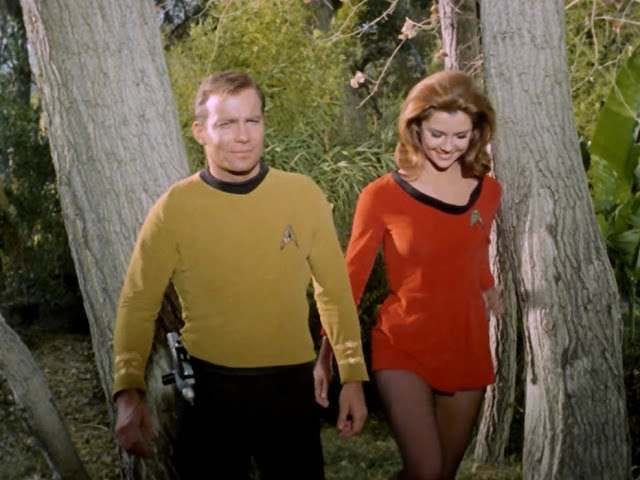
It might be important to note, here, that Roddenberry would probably be considered “conservative” today, or moderate at worst. He could never get get his foot in the Hollywood door in the Current Year, or for the last quarter century. There are plenty of clues as to his position on the political spectrum, but maybe none as revelatory as his teleplay for “A Private Little War” in which the Federation fights a proxy conflict on a primitive planet. The Vietnam allegory is difficult to miss, and Captain Kirk spends the epilogue of the episode defending LBJ’s police action in the name of “peace.” To be fair, Truman had gotten us started on the Forbidden Victory slippery slope, and the “Domino Theory” was around since Korea or earlier. But the Johnson Administration obviously believed a hamstrung US military as world policeman and a balance of power with the USSR was the path to global harmony. Roddenberry endorsed that policy.
Roddenberry pitched the series as “Wagon Train to the Stars,” initially. That ostensibly meant that, unlike Twilight Zone and Outer Limits, this science fiction series would have a continuous core cast of characters. (This aspect was stolen after a pitch session, according to Roddenberry, and was employed to launch the original Lost in Space.) But it’s probably no coincidence that Wagon Train itself was right-coded: strong men leading a colony of settlers through a wild frontier, battling nature and other strong men to get to where they could tame the wilderness and build a civilization in it. There was no shortage of attractive women in the wagon train for the stout pioneers to win, and heroes had to punch villains in the face from time to time.
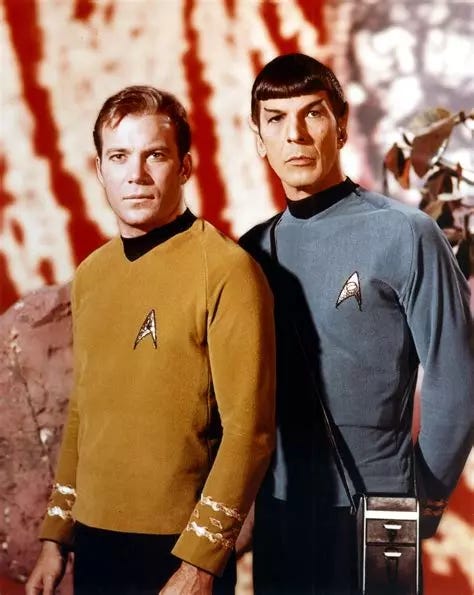
In Roddenberry’s original treatment, he described Spock as “satanic” in appearance. But it was “Number One” who was the logical, emotionless second-in-command. I’m sure Next Generation fans automatically think of Riker when they hear that moniker. But the original Number One was a woman. It was that, more than anything, which convinced Lucille Ball (of Desilu Studios) to commit to Star Trek when everyone else turned Roddenberry down.
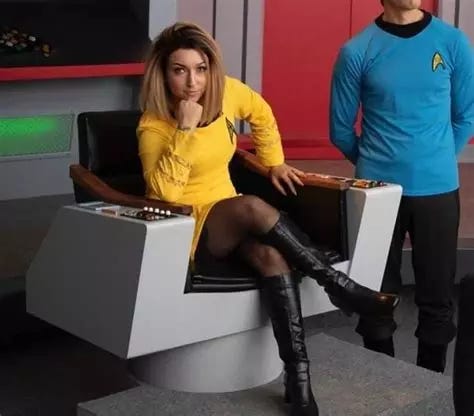
If you watch the pilot episode (“The Cage”), you’ll see the characters closer to how Roddenberry conceived them. But the suits at NBC gave him an ultimatim before they would give his show a second chance: Either cut the female First Officer, or cut the “Satanic” Science Officer. That’s not how you boil frogs, Gene. Push the Overton Window too far, too fast, and the unwashed rubes will jump out of the pot. So before the series got the green light, the two characters were combined and Spock would become the cold, calculating Vulcan we are so familiar with today. (With Next Generation, a female “combat specialist,” Tasha Yar, was introduced in the first season. The character didn’t cross over into subsequent seasons, but it was obvious what direction Roddenberry was pushing.)
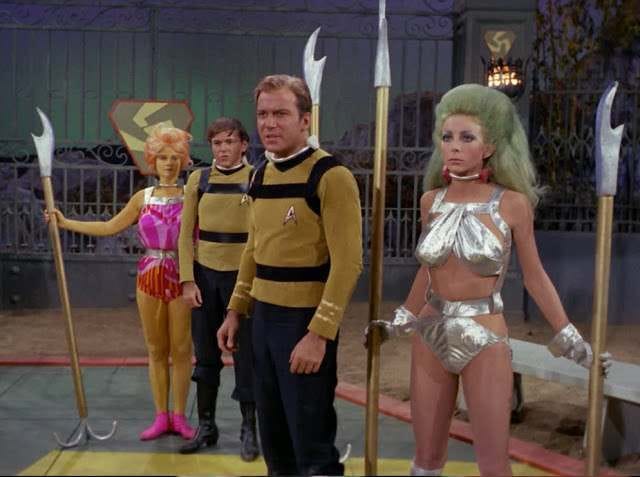
Roddenberry not only had his vision of a United Nations in Space, to push, but plenty of morality plays and intellectual navel-gazing to inculcate his audience with, as well. He would need right-coding to sell it to the TV audience. That meant it had to look like an adventure series—not an artsy-fartsy psychological drama.
So his Starship Captain would be a man of action.
First Captain Pike, then Captain Kirk, were inspired by Horatio Hornblower. Despite all the technology available in this alleged future, and man’s evolved commitment to order and balance, Kirk would need to settle matters with his fists frequently. One reason I never latched onto the series as a child (despite it being available for viewing at any time and on any channel) was because Kirk’s patented chop/hammer fist to the shoulder blade never once scored a knockout for me in the school yard. I still chuckle at the fight music, though, and can hum it from memory.
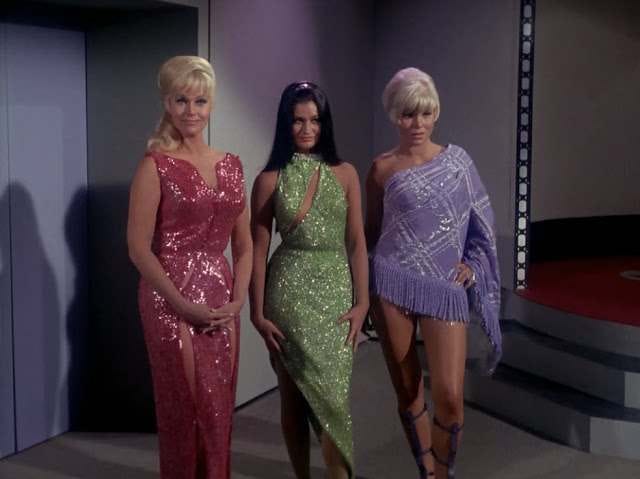
Kirk would also encounter a hot babe (by 1960s standards) on pretty much every planet the USS Enterprise visited. He didn’t just get the girl, he got the girlS. Spock and McCoy scored once or twice, but poor Scotty, Sulu and Chekov were futuristic incels, even with Lt. Uhura right there on the bridge, and plenty of other nubile chicks in uniform on the ship.
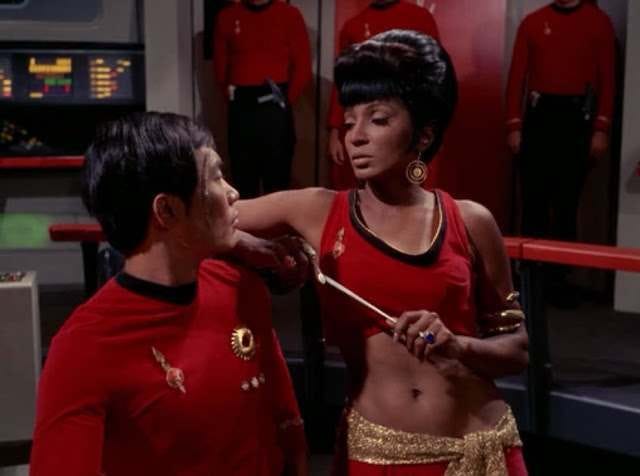
Like the characters from Wagon Train, there is also the subtle implication that Starfleet is also settling the frontier. The final frontier, of course. The Federation has colonized some planets, but these are not builder heroes—they’re explorer heroes. “…To explore strange new worlds…to go where no man has gone before” were effective hooks, in Kirk’s monologue at the beginning of every episode. It’s all right-coded, to make socialism look appealing.
In Current Year entertainment, right-coding leftist messages is everywhere you look. It was happening before Roddenberry ever developed his idea, too. But his pioneering sci-fi series was a crucial step along the way.
What do you think?
Speaking of Right-Coded Entertainment…
My graphic novel will be crowdfunding soon. The “right coding” in the story is not a disguise, in this case. It’s just honesty.
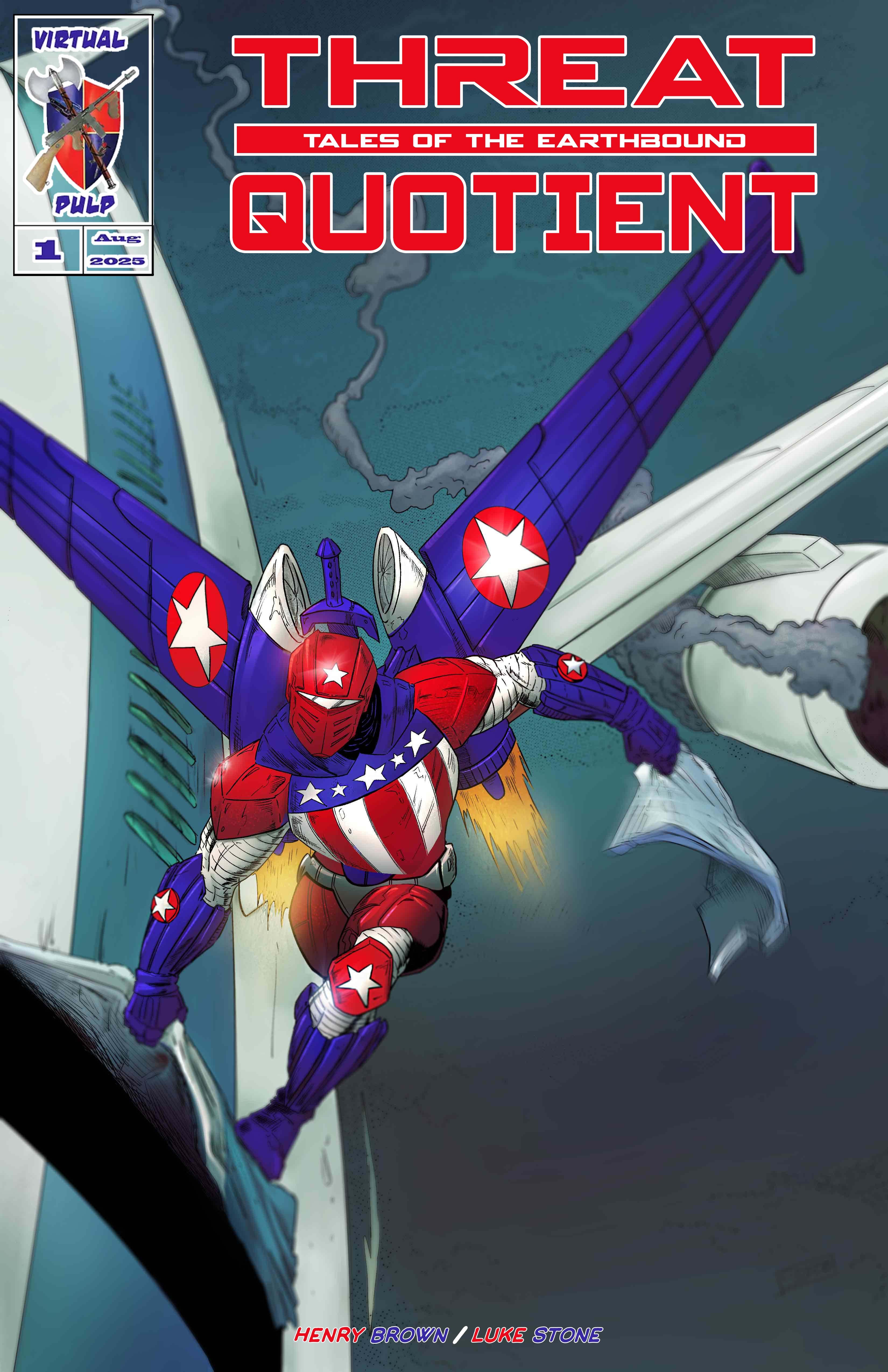
Threat Quotient is a 108-page full color graphic novel about a clash of superteams—one aligned with the globalist Establishment and one that best represents the “dissident right.” The pre-launch page is up on Kickstarter already, and the FundMyComic campaign should launch in early April. I invite you to sign up for a notification when the campaign begins. If you haven’t binge-read the digital version on Virtual Pulp Press yet, you should do that.
"Pssst, Uhura, you're wasting your time!" That made me🤣
I think present-day Marxists have strayed so far to the Left that those of us on the so-called "Right" are actually normal. When we refer to ourselves as "right-wing," we're playing to the Marxists' hand--that's one of their labels for those who disagree with them. But I think that is for another article.
I started noticing TNG showing its Marxist stripes when Starfleet characters would disdainfully refer to Ferengi as "capitalists."
I thought it was so interesting in that Rotten Berry interview where he talks about how he likes to look at his daughters panties when they bend over and how when he was a kid he dreamed of growing up to be a rapist or a thief and how his strongest belief is that the devil has backed him up his entire life.