
Generational Storytelling VIII
The Hero Archetype

“Everybody’s got to do their part.”
“Ask not what your country can do for you, but what you can do for your country.”
“With great power comes great responsibility.”
“Now wait, Hank. You’ve gone way too anachronistic. Those last two came from the early ‘60s, while Boomers were taking the baton from the Silent in that ‘rising adult’ phase of life.”
Correct—but both originated from G.I. Generation men, and sum up the civic-minded nature of the Hero Archetype quite well.
This member of the historical quartet is where a generational archetype arguably enjoys significant overlap with the literary archetype of the same title.
My usual disclaimer about ignoring exceptions applies: the Heroes tend to be self-sacrificial, confident, optimistic team players and builders.
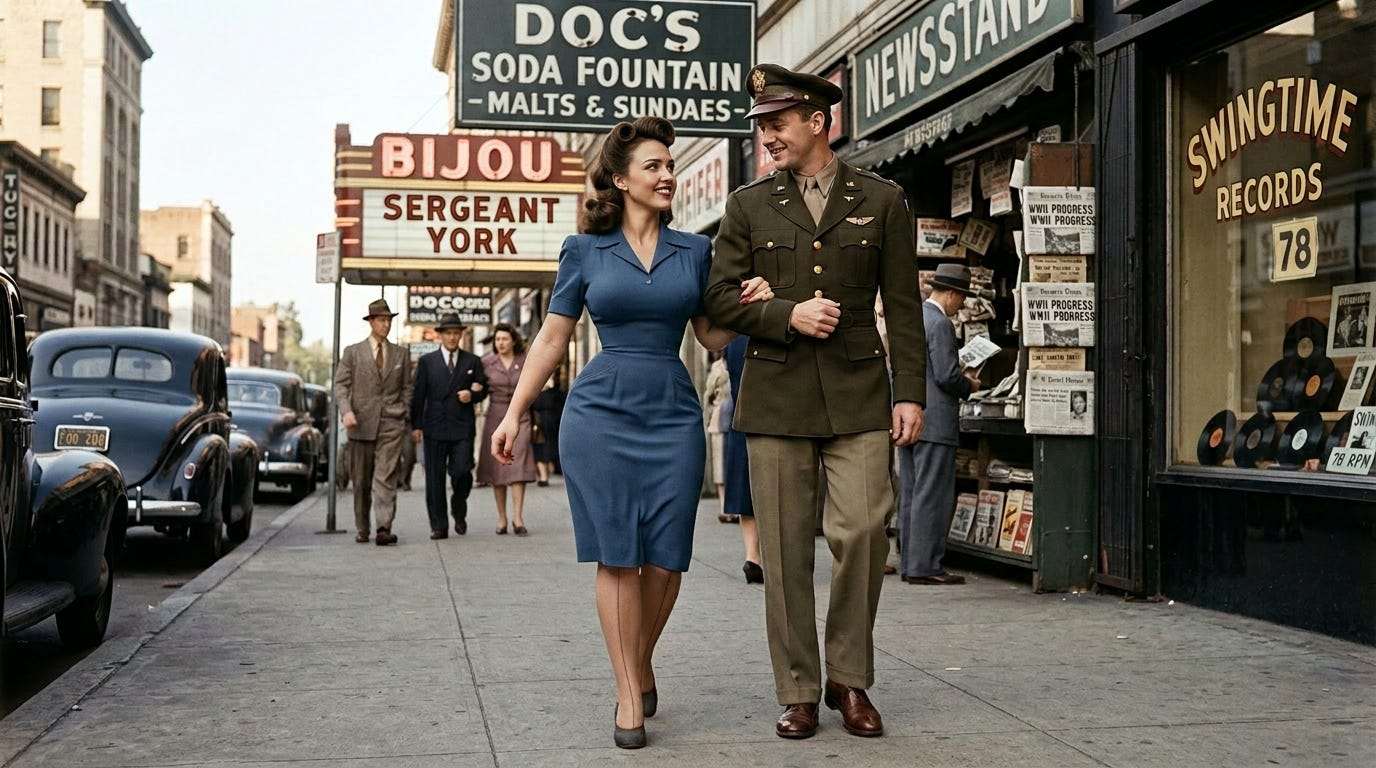
The previous Heroes were the G.I. Generation (born 1901-1924, labeled “Greatest” by non-GT-savvy pundits) and the current Heroes are the Millennials (born 1982-2004 and labelled Y, Z, Zoomer, Karen, and/or Generation Snowflake, depending on who you listen to).*
Heroes are in the “childhood” phase of life (age 0-20) during a Third Turning, or “Unraveling.” Society has fragmented; individualism is high—as is cynicism, crime, and apathy. But Heroes are the “good kids” in the generational family and usually overprotected by parents and society.
I noticed this long before I knew about Generational Theory and just wrote it off as a linear trend toward an increasingly invasive nanny state. (It was that, for sure, but it was also part of the cyclical pattern I still couldn’t see, then.) New parents put “Baby on Board” signage on their vehicles so other drivers would be more careful around somebody hauling precious cargo. Bike helmets seemingly appeared out of nowhere and became mandatory for kids. Suddenly, bullying became a big deal (even though by then it was almost nonexistent compared to what X went through) and the whole country mobilized to crack down on it. At Halloween, when I went trick-or-treating, sometimes whatever parent had custody of me wasn’t even home. When they were home, they advised me not to accept an apple because some psychopath might put a razor blade in it…otherwise be back around midnight but don’t make a lot of noise coming in. It seemed to be the same for most of my contemporaries. But for the Millennials, they went in groups escorted by an adult, or they didn’t go. At least that I ever saw.
In the generational family, Nomads are the biggest risk-takers while Artists are the most risk-averse. Prophets and Heroes come in second in those categories, respectively—at least as children. But I’ve noticed that many Millennials are still scared of almost everything, even as adults. If you think about it, when one of them does something extremely dangerous, they have to draw on far more courage than one of us who didn’t care as much whether we lived or died, back when we did it.
Despite how highly they value their lives, a defining characteristic of the Hero archetype is the willingness to put their life on the line for others—family, community, country. We easily see that in the G.I.s, because the Great Depression and WWII are matters of historic record and easily examined in retrospect.
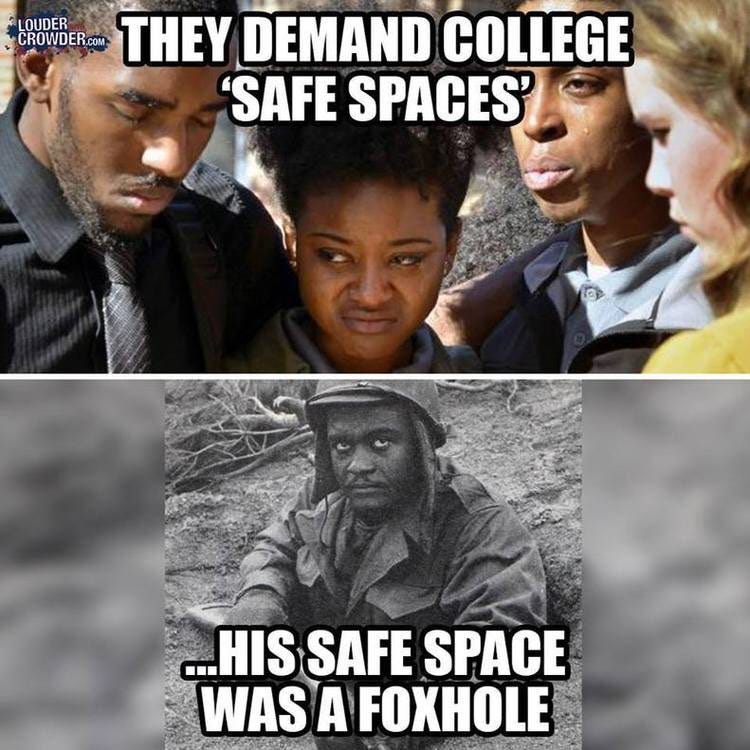
It’s harder to imagine the Millennials stepping up to resolve this Fourth Turning with the same determination, but I’m gonna give it time to see how this plays out and if the pattern holds. I expect at least a percentage of them to unite somehow in the effort to implement a solution (not necessarily a good one) with a high degree of teamwork, selfless dedication, and a can-do attitude.
I was about 11 when I dreamed up the character of Turbo-Knight. He originally had intentionally boxy armor and rode a hover cycle instead of a horse, wielding a lance which could punch a hole through a concrete bunker.
As I grew up, I remembered the character and updated him according to new information I acquired. Included in that information was a grasp of what chivalry was, literally, and how the word is used, figuratively, in conversation.
At the age of 15, I became obsessed with every aspect of WWII—including the “Home Front.” What blew me away was what a completely different country America was, back then. And I don’t mean technologically.
In addition to reading whatever books and watching whatever movies I could about what happened during that season of history, I knew and met people who lived through it.
To be sure, there were communists and perverts around back then, too, but they were the exception and had to walk softly, pretending that the New Deal was simply just Common Sense Economy Control, for a free market that had supposedly run amuck. And the Soviets were freedom-loving allies who were simply anti-fascist, and totally trustworthy.
But the average American normie who had lived through those times was horrified and disgusted by what had happened to America…by the 1980s. Over the years I reflected on the observation that the American Dream, and everything associated with it, was as lost to history in my temporal environment as Chivalry was.
Using the term figuratively, the G.I. Generation was rather chivalrous—not just opening doors for women, but letting them take your taxi cab when you were first; carrying their bags for them when you didn’t know them and would probably never see them again; pulling over to help a stranger with car trouble; giving a down-on-his luck vagrant a meal, a bath, a change of clothes and pocket cash with no thought of ever getting paid back. I’ve seen diminished echoes of all that even in my life, and maybe you have too if you grew up rural—but it was an antiquated throwback when we did. It was normal life for the G.I. generation—maybe even for people who lived in urban hellholes like Chicago and New York.
Captain America came from that era, but I don’t think the culture shock resulting from his man-out-of-time scenario has ever been portrayed with the right gravitas. The early Marvel movies subtly alluded to it, but nobody involved would never have the honesty or the guts to depict it as it would actually play out.
Anyway, somewhere along the way, I decided that Turbo-Knight should not only be romantic about literal chivalry, but a paragon of figurative chivalry as well. Later, after my introduction to Generational Theory, I realized I had conceived an aspirational hero from the G.I. Generation. Then the other aspects of this character all fell into place.
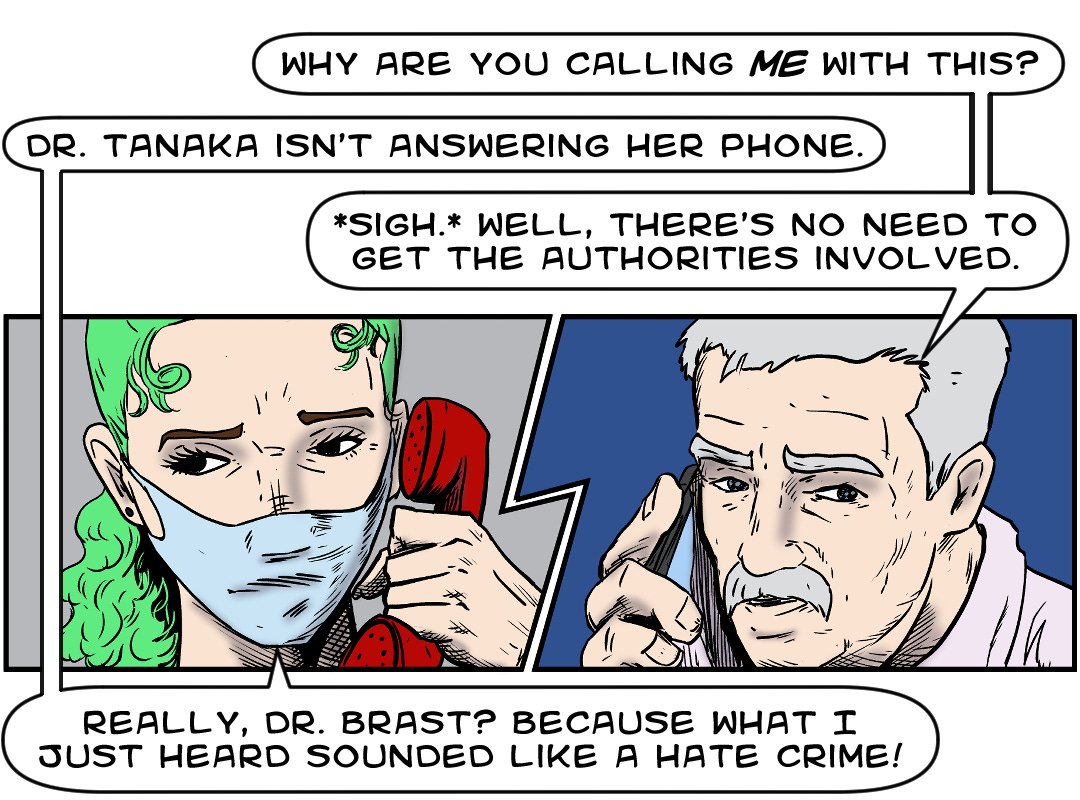
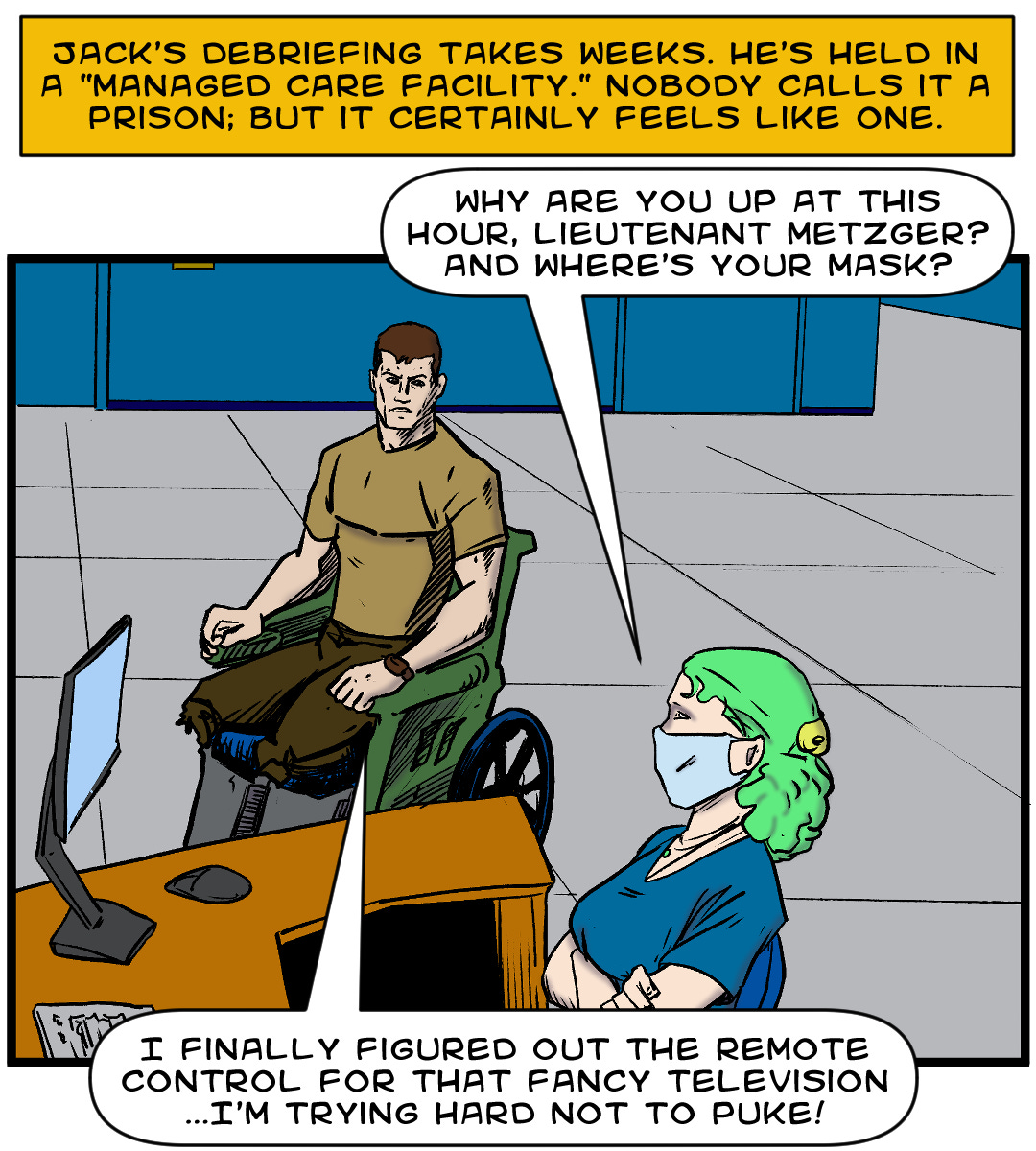
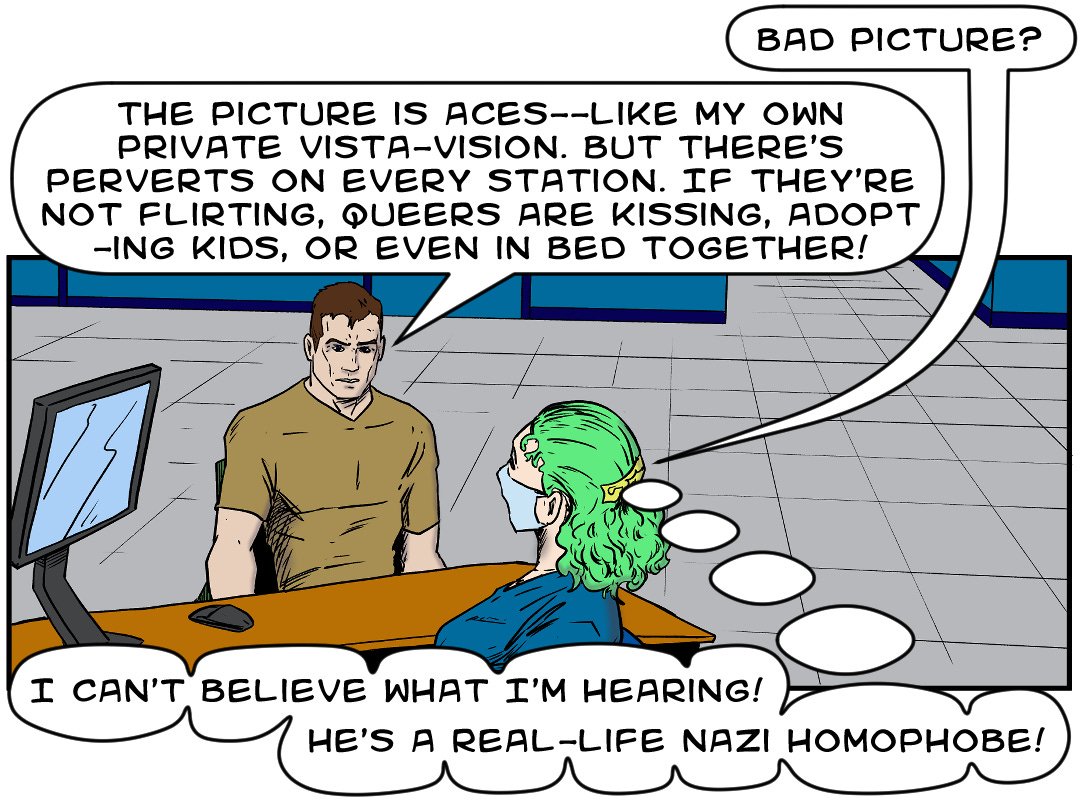
John “Jack” Metzger was a young P-47 pilot in the ETO, who had grown up dreaming both about flying and about knighthood. When the weather cleared over the Ardennes in the winter of ‘44-45, his squadron was unleashed to mangle the panzers which had pushed the Bulge into allied lines. Metzger was shot down and lost both legs at the knees. But he took it in stride—that was a price worth paying to save the world from Hitler. He was supposed to believe that, and he did.
Metzger is also a builder, and doesn’t let stuff like mere impossibilities slow him down. Logically speaking, it was impossible to get the USS Yorktown repaired in time to face the Japanese Navy at Midway. And yet the G.I.s did it. With the same kind of can-do spirit, Metzger built an armored “battle harness” with robotic legs so that, not only can he walk again when wearing it, he can fly, too.
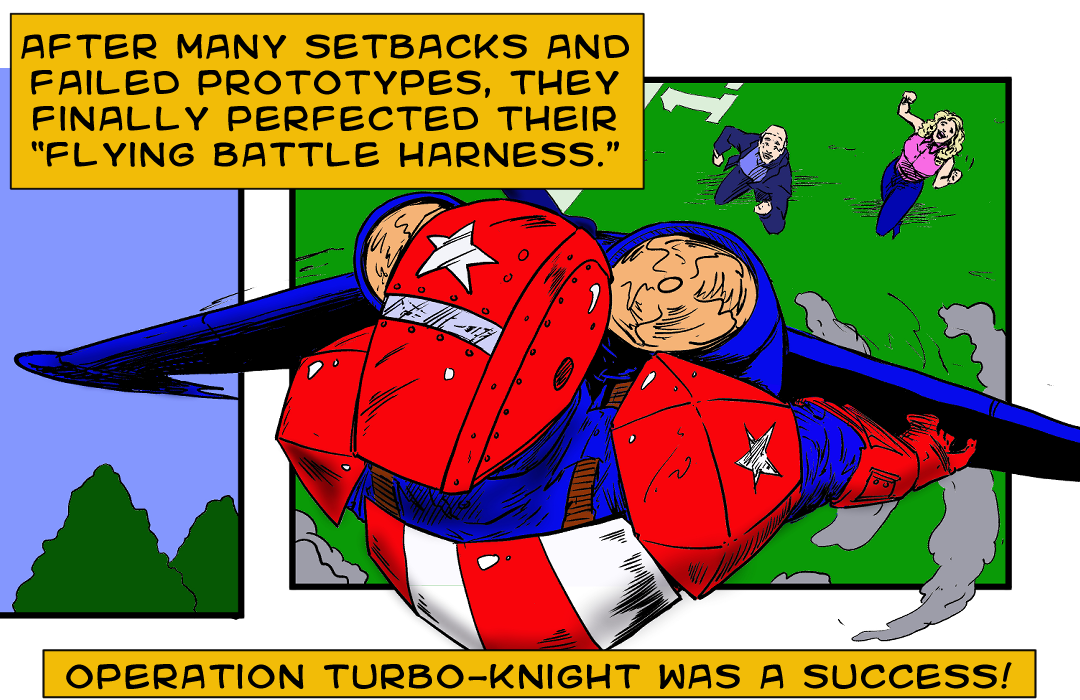
By the time of the Korean War, Metzger’s flying battle harness is functional. He uses it to rescue American pilots shot down behind enemy lines. That is where and when he is swallowed up by the cosmic quake and spit out a dimensional crevice into the Covidiocy Era.
Turbo-Knight, AKA Ramjet, is probably the first aspirational hero I’ve written as an adult. But he’s not the only Hero in Tales of the Earthbound.
I mentioned Caleb Spectre (Phantom Leader) while writing about the Nomad archetype. He’s got four sons: a Homelander (the youngest) and three Millennials.
With Gavin (Phantom Courier, the oldest), I strayed from the Hero peer personality somewhat. He’s been frustrated and demoralized by a world wherein the “white hats” are in the habit of screwing citizens over.
Marvus (Phantom Mage) is the most talented hacker, but also going through a hip-hop hood-rat-wannabe phase. Hector (Phantom Raider) is the go-to direct action member of Phantom Force—a martial arts prodigy with natural acrobatic ability. Both of them have a can-do attitude, and can’t be held down for long.
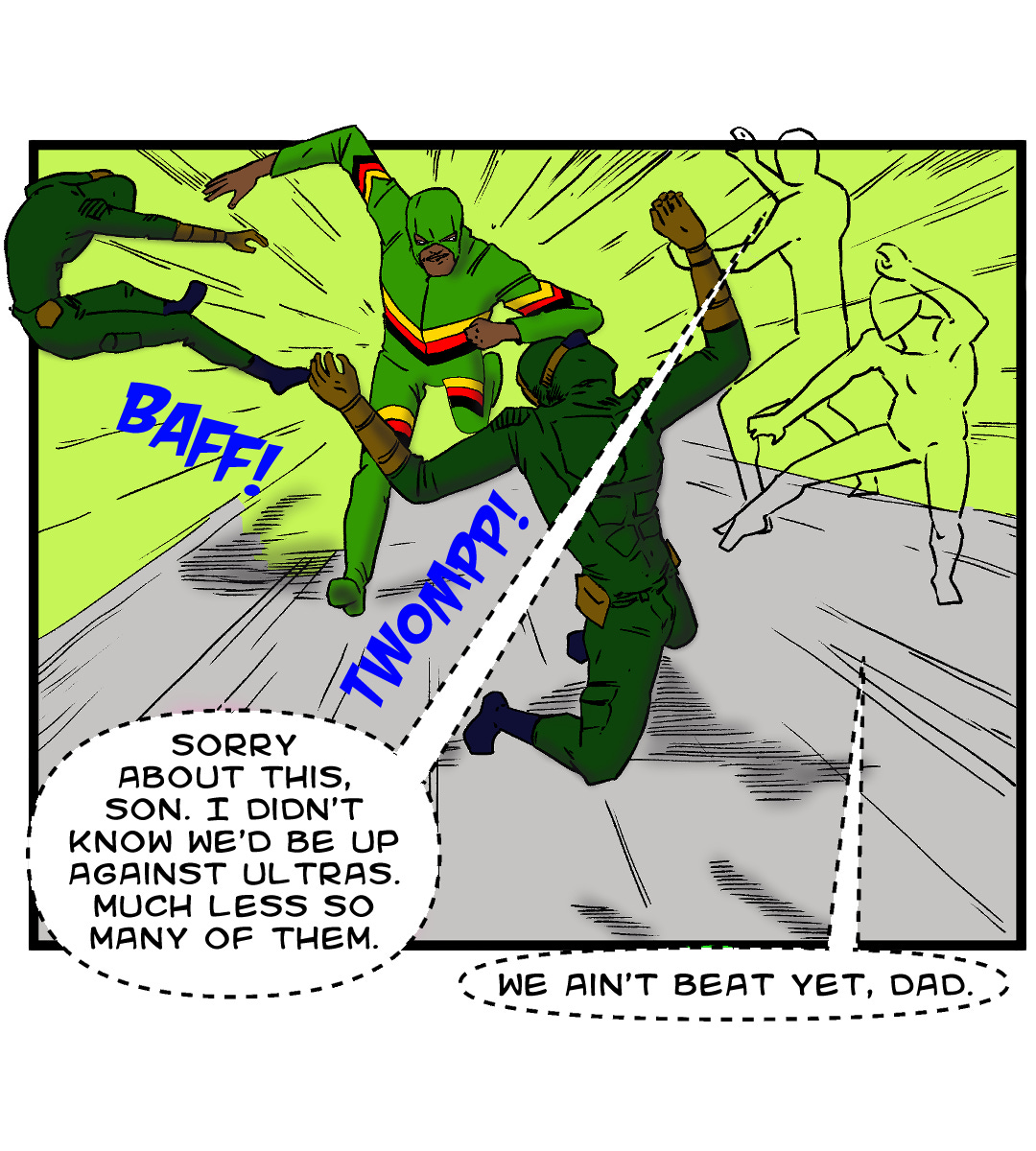
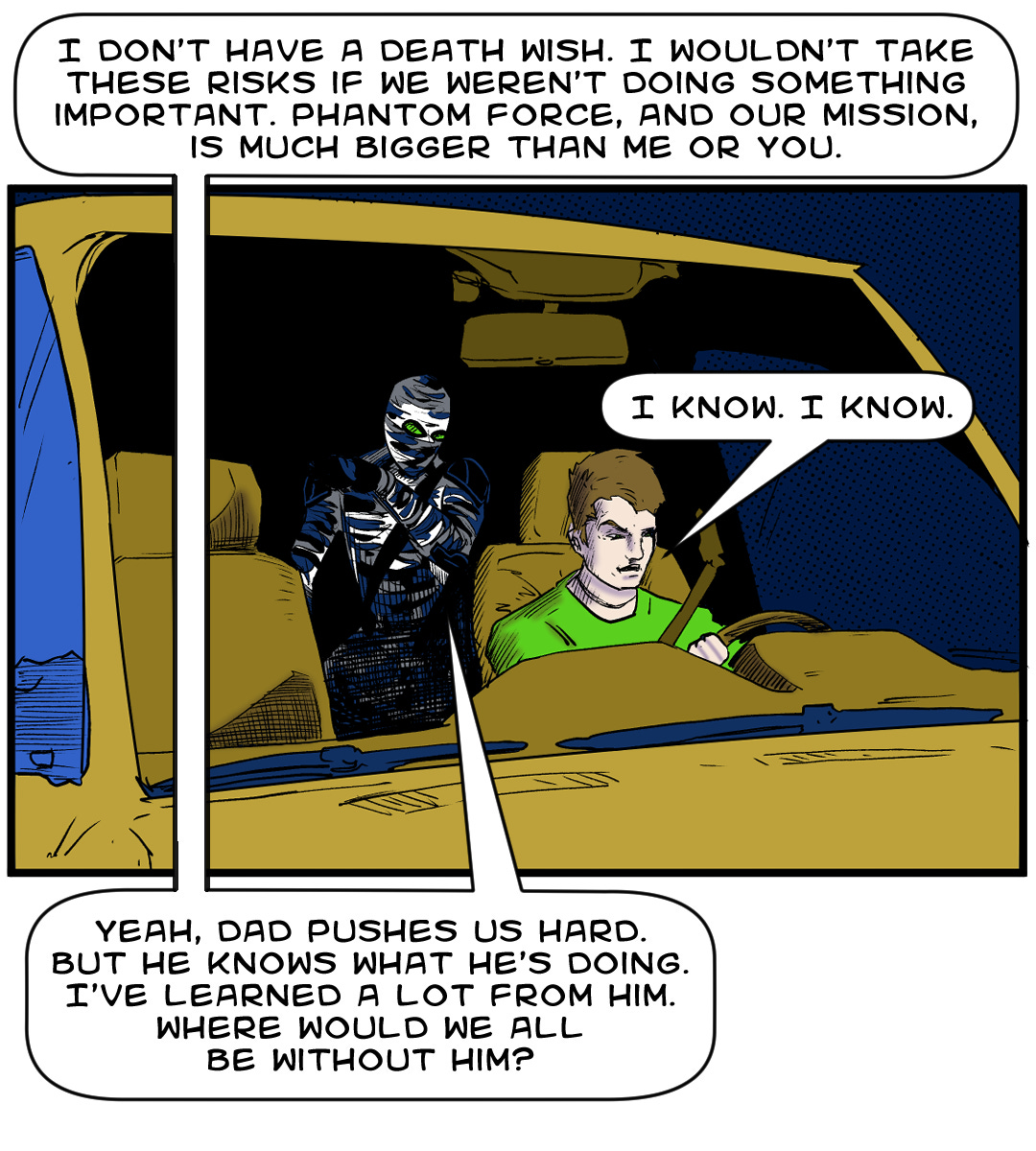
All are exemplary team players. All are self-sacrificial. Gavin is the practical worry-wart. His optimism is quenched by him dwelling on how his country has been hijacked and his community corrupted beyond recognition. Marvus, Hector and Jaden (Phantom Sentry—the youngest) dwell instead on the goals/needs of their intact, uncorrupted family—Phantom Force.
Heroes are loyal followers, in their youth. These young men follow their father with the same dedication the G.I.s followed Lost Generation (Nomad) generals like Patton and Vangergrift. The Phantoms serve their family—not the State. Caleb is not a perfect leader, but heroes don’t require perfect leadership. Their father still deserves their allegiance, as they see it, and commands their respect. They are more than happy to give it.
Turbo-Knight seeks worthy leadership to follow, but is having a tough time finding it in Clown World. The blind faith in institutions he learned in childhood will be sorely tested as the series unfolds. He is compelled to do what is right…but in a world that twists the definition of right and wrong, does he adopt the new paradigm that grates against his conscience, or cling to his “outdated” morality and try to change the world?
*Since the oldest Homelanders are currently old enough for military service, and the oldest Millennials are aging out of it, I halfway expect Neil Howe to adjust his and Richard Strauss’ demarcations. They initially placed our entry into this Fourth Turning (Crisis) at the beginning of the Housing Bubble Bust/Great Recession, which means the first cohort of the next Artist generation would have started about three years before. But seeing as how America still hasn’t entered the climax of this Crisis, I’m wondering if that wasn’t premature. Or maybe this will be the opposite of the Civil War saeculum, and drag on much longer than previous Crises have, with no other adjustments required.
This is Not Your Typical Cape Comic:
I consider it part of my job as a storyteller to develop interesting characters grounded in reality. Same with the relationships between characters. I take my job seriously, so that’s precisely what I’ve done in Threat Quotient—my first expansion into sequential art storytelling, and the realization of a die-hard childhood dream.
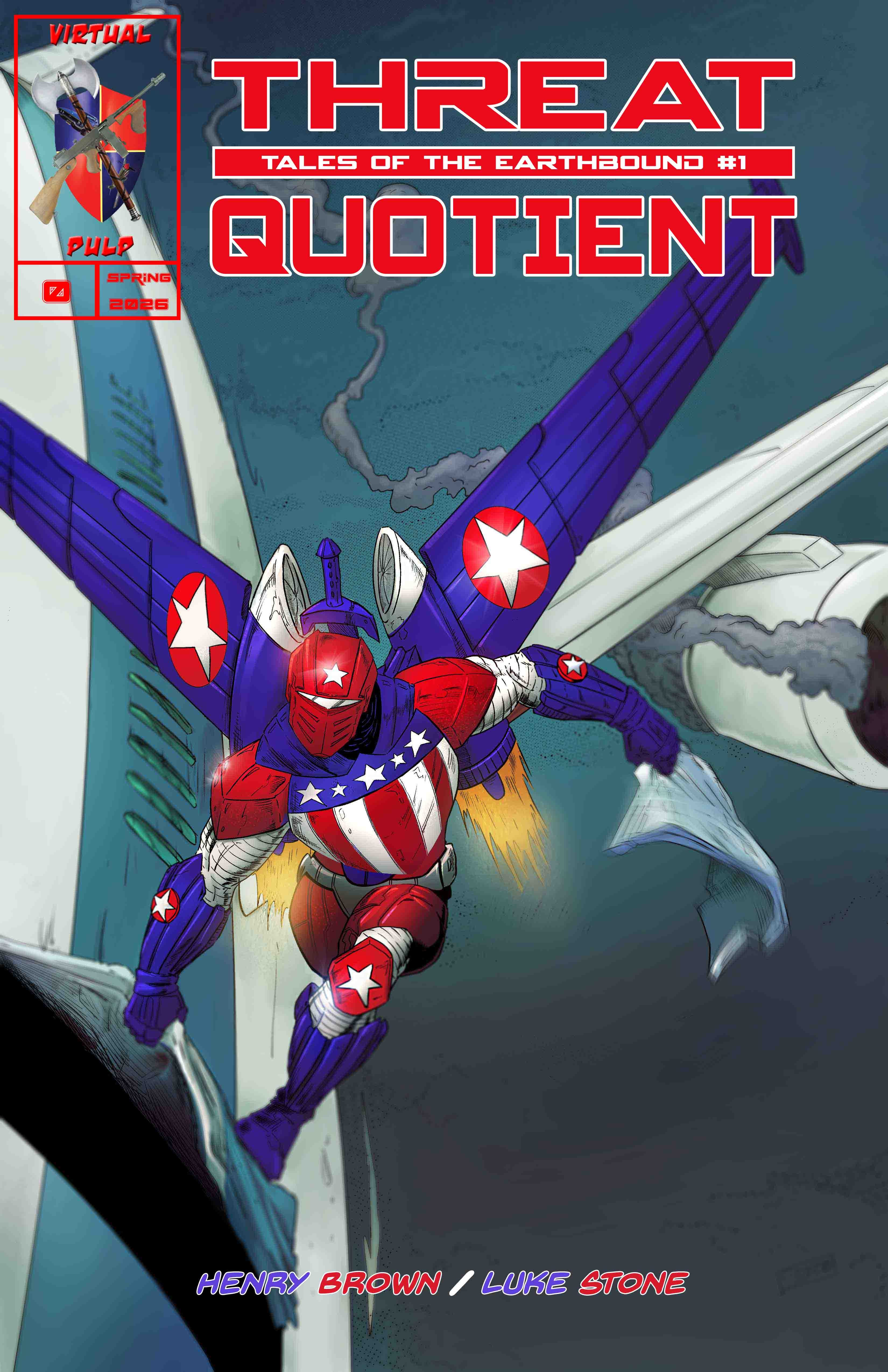
Tales of the Earthbound is a planned series of graphic novels set on an alternate reality with superheroes. Threat Quotient is the first in the series—a 108 page full-color ensemble superhero epic designed to treat readers to all the thrills and dopamine hits fictional stories have tried to illicit since time immemorial.
Back it on Kickstarter today! We can make American comics great again, starting here.
Continuing to enjoy this series on how you used generational models to inform your character building for this comic.
You're spot on about most Millennials are not chivalrous compared to the G.I., particularly in the sense of the previous generations. I think the discrepancy you see between the G.I. and the Millennials may be that the Millennials--due to their cultural influences like media, Clown World, and the rise of computing--function more on the realm of personal ideals and causes. The G.I. generation grew up in a vastly more homogenous society compared to the Millennials, after all.
Compared to the G.I.s the Millennial congregate in tribes. The simplest example I can think of right now is how atomized their fashion is as a collective whole compared to any of the other generations. They dress according to their sub-culture of ideals and causes, and decorate themselves with the associated status symbols. So, those in the finance subculture dress as finance people "ought to" dress, with the requisite status symbols such as watches, cars, and Instagram photos.
And there are subcultures within subcultures. Those in the "outdoorsy" subculture have closets full of their chosen "outdoors" ideals. The city dwellers may have closets full of The North Face gear. The granola lovers may have a collection of REI and Patagonia gear. And so on, with "backpackers", "ultralight" enthusiasts, and so on.
But that's just the surface. If you are confounded by how Millennials dress, it's because they mix and match status markers. A simple illustration is the common case of a young man in a well tailored suit wearing sneakers. Absurd to older generations, but makes perfect sense to Millennials. What type of sneaker is he wearing? Vans? Finance dude who skateboards. Nike high tops? Basketball. And so on.
The popularity of "tier lists" in Millennial men is another example. It's a way to demonstrate one's ideals in a nuanced way. Likewise with Millennial women and their highly personalized insulated mugs (e.g., Stanley mugs).
Going a bit deeper, each subculture has their own "rules of chivalry", so to speak, a nuanced code of conduct that demonstrate's one's identity.
And you're absolutely spot-on about Millennials highly invested in family.
In all, the simplest way to understand a Millennial is to decode their personal status markers. These markers serve as a map of what causes they stand for.